

From SEO to AISO: How Generative AI is Redefining Global Visibility
The New Search Revolution: AISO Explained
As artificial intelligence reshapes how people search online, global companies face a new visibility challenge. Generative engines like Google’s Search Generative Experience (SGE), Bing Copilot, and ChatGPT are changing the rules of discovery. Instead of presenting lists of links, these systems generate summarized answers drawn from thousands of data sources – effectively deciding which companies appear in their responses.
For U.S. exporters and internationally minded brands, that shift raises important questions.
If your company already has a strong U.S. website, do you still need localized sites for each market?
How do AI systems “see” those international versions compared to your main .com?
Welcome to the world of AI Search Engine Optimization (AISO): the next evolution of SEO, where visibility depends on how well your digital ecosystem speaks the language of AI.
From SEO to AISO: The New Rules of Online Visibility
Traditional SEO focused on keywords, backlinks, and content freshness. Those factors still matter, but AI-driven search adds a deeper layer: contextual authority.
Generative engines don’t simply rank websites – they synthesize insights. They identify sources that demonstrate expertise, credibility, and relevance to a specific question or market. In this new landscape, structured, localized, and semantically rich content is the currency of visibility.
Early research confirms this shift:
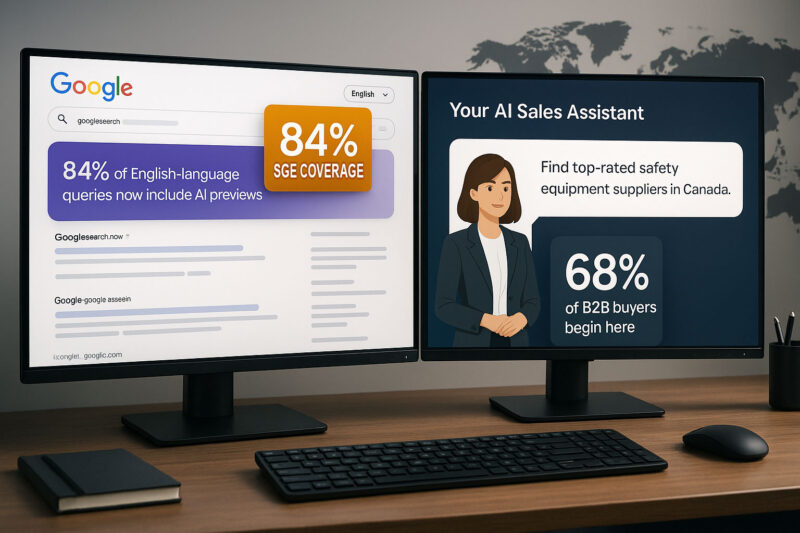
- Google’s SGE previews appear in over 84% of English-language queries (BrightEdge, 2025).
- 68% of B2B buyers now start their research through AI-assisted tools (LinkedIn B2B Institute, 2024).
These trends validate the strategies long embedded in IBT Online’s localized marketing programs, which prioritize on-page optimization, content localization, and structured data to ensure companies remain visible in every market.
Why Localized Websites Still Matter in the AISO Era
A decade ago, global SEO often revolved around a single, English-language domain. But in 2025, that approach risks invisibility in AI-driven search.
Generative engines recognize linguistic and cultural context. A user in Germany searching for industrial sensors or automotive coatings will receive AI summaries weighted toward German-language content hosted on local or regionally optimized domains.
Localized websites deliver exactly that:
- Local trust signals such as language, domain extensions, local hosting, and market-specific case studies
- Improved user experience and engagement metrics that reinforce authority
- Higher inclusion rates in AI-generated summaries due to contextual alignment
According to SEMrush’s 2025 GEO Insights, localized domains are 2.4x more likely to appear in AI-generated summaries than generic global pages. This is because generative models learn to prioritize local authority and relevance – not just brand name recognition.
AISO doesn’t replace localization, it amplifies it. The better your localized websites reflect real local demand and behavior, the more likely they are to appear in AI-generated visibility layers.
How LLMs ‘See’ Your Global Web Ecosystem
Large language models (LLMs) like GPT-4, Gemini, and Claude don’t crawl the web like traditional search bots. They ingest, interpret, and summarize information using patterns and probabilities.
When these models generate answers such as “best suppliers of industrial tools in Europe” or “where to buy safety equipment in Canada,” they rely on signals like:
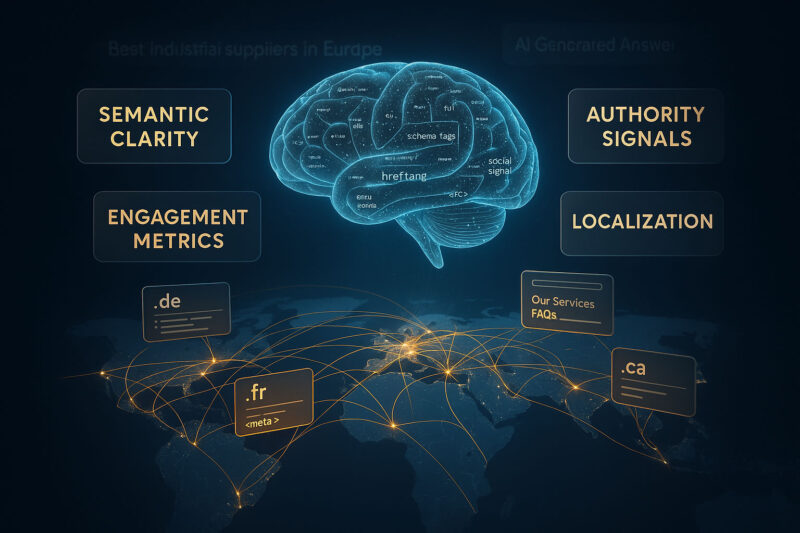
- Domain structure: country-code domains (.de, .fr, .ca) or hreflang-tagged directories
- Semantic clarity: headings, FAQs, and metadata that map relevance
- Authority clustering: interlinking between main and local sites to reinforce brand trust
- Engagement signals: social activity, backlinks, and behavioral data
This means LLMs perceive your brand as a network, not a single page.
Companies with mature, multi-market websites have seen a 45% increase in international visibility after implementing structured data and localized schema (IBT Online internal analysis, 2025).
IBT Online’s programs combine on-page SEO, AI-readability optimization, and local marketing to ensure every market-specific site earns its place in AI-generated search results.
AISO Best Practices for Global Companies
To position your company for success in the AISO era, focus on these five key priorities – supported by current data and real results:
- Create locally relevant, structured content.
Pages with clear hierarchies, FAQs, and schema markup are up to 35% more likely to appear in AI-generated answers (Semrush GEO, 2025). - Maintain language and cultural authenticity.
LLMs detect tone, syntax, and contextual nuance. Authentic, human-localized language improves engagement and signals regional authority. - Integrate AI visibility analytics.
Track how your pages appear in generative search using tools like GA4 and Semrush to monitor AI-driven traffic and keyword clusters. - Leverage SEM and SMM strategies.
Paid and organic engagement feed AISO performance. Brands using both SEM and SMM optimization see a 22% higher inclusion rate in AI-generated responses (IBT Online benchmark data, 2025). - Interlink your global domains.
Connect each localized site to your U.S. domain to reinforce brand consistency and strengthen LLM recognition.
The Future: AISO and International Growth
Generative search isn’t the end of SEO… it’s the next step in its evolution. The rise of AI-powered discovery reaffirms what exporters and global marketers already know: international growth depends on being found where your buyers are searching.
Localized websites remain your best tool to ensure AI engines identify your business as relevant, credible, and available in-market. When paired with AI-ready content, structured data, and a localized digital strategy, they help your brand rise to the surface of every generative conversation.
With the right AISO strategy, you can future-proof your online presence and turn generative AI into a growth driver, not a disruption.
Ready to make your brand visible in the AI search era?
Blogs
- AI Visibility & GEO (8)
- All posts (106)
- Avatars & Videos (6)
- Digital Marketing (59)
- Distributors, Resellers, & Agents (10)
- Ecommerce Solutions (16)
- FAQ (1)
- HubSpot (5)
- Localization (42)
- Market Insights (52)
- Success Stories (16)
- Website Design & Development (18)
Similar Posts

Google made AI Search the default. Is your business still showing up when it matters?

How to Find, Recruit, and Manage International Distributors, Resellers, and Agents: With Your Website Doing the Heavy Lifting

AI-First Digital Marketing: How IBT Online is Building Claude AI Expertise Across Every Service Line